

The global media and entertainment industry is faced with an inherent infrastructure problem. The transition to 4K and 8K resolutions, AI-based workflows, and ultra-low-latency live streaming has created unprecedented pressures on compute density, network bandwidth, and deployment speed. Traditional air-cooled data centers—so far the broadcast industry’s workhorse—are hitting physical and economic limits.
By Larry Haley, CEO of Trilogy NextGen, USA.
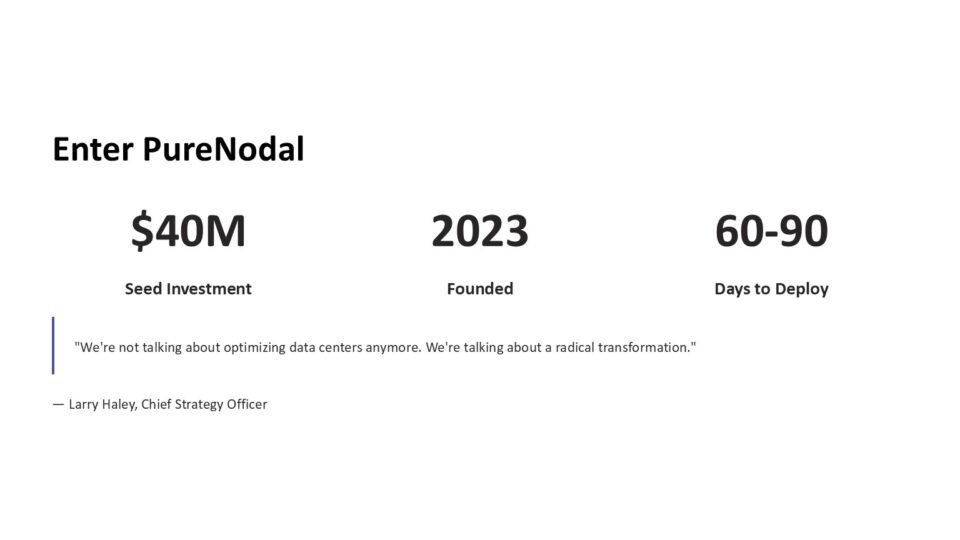
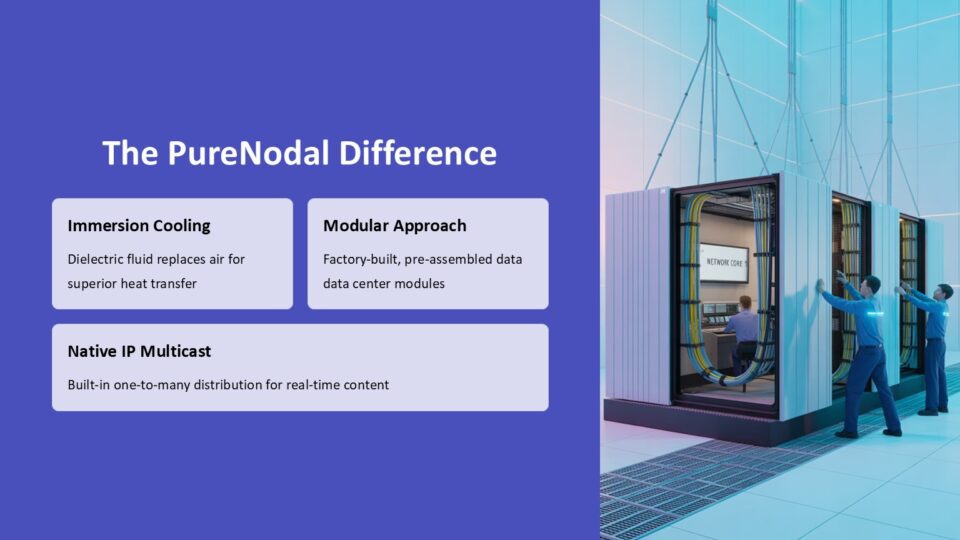
PureNodal, backed with $40 million of seed investment, was founded in 2023 as a response to the crisis. The Texas-based startup’s strategy is to combine immersion cooling technology with a rapid-deployment, modular approach and a cloud platform designed with AI workloads, streaming, and broadcast in mind. Most significantly, its networking infrastructure was designed from the beginning to support IP multicast—not as an afterthought, but as a native capability. This architecture provides broadcasters with a one-to-many distribution method, essential for delivering real-time content without the inefficiencies and complexities of overlay solutions.
We’re not talking about optimizing data centers anymore. We’re talking about a radical transformation in where and how quickly we can provision the vast amounts of compute power that new media requires.
 Why Traditional Models Are Failing
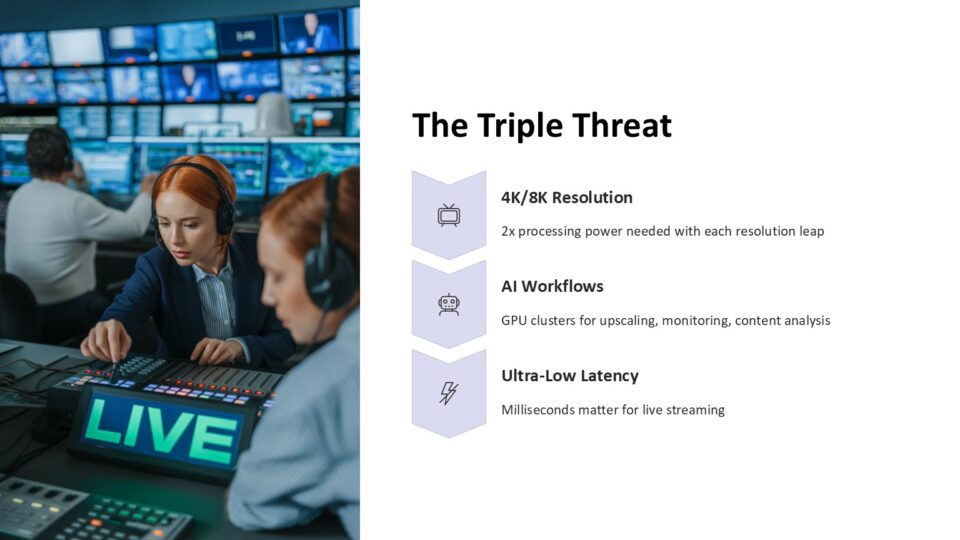
For decades, data centers have addressed rising demand through incremental growth in power and cooling capacity. But the “triple threat” of resolution, AI, and live content has pushed this approach to the breaking point.
With every resolution leap—4K, and now 8K—takes twice the amount of processing power to encode, transcode, and play out. AI-driven upscaling, machine learning-based quality monitoring, and advanced content analysis all require densely packed GPU clusters burning their candles at both ends. And simultaneously, low-latency sports streaming, news, and interactive applications don’t allow for delay—latency must be measured in milliseconds, not seconds.
Ten years back, a standard rack would pull 4–5 kW. Today’s high-performance racks are easily above 50 kW, and AI-informed designs well over 100 kW. Air cooling cannot possibly work effectively at these densities. It’s not a matter of cost—it’s physics that prevents it.
To this technical cap, a time-to-market issue is added. Traditional data center build times range from 18 months to five years, from site selection through go-live. In an era where broadcasters are launching new FAST channels in weeks, any such delay becomes strategically unacceptable.
 Immersion Cooling as a Strategic Enabler
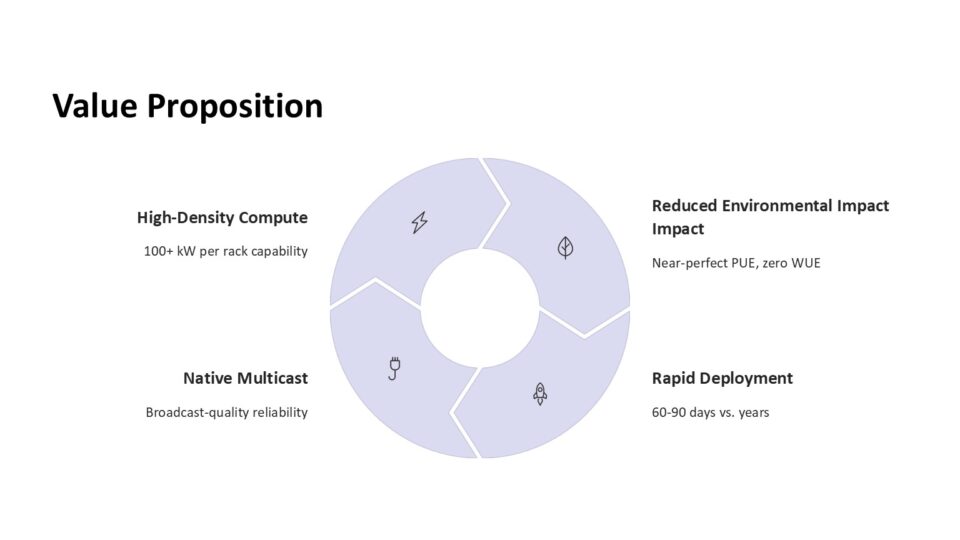
Immersion cooling replaces air with a dielectric fluid to conduct heat much more reliably and efficiently, enabling rack densities of more than 100 kW while achieving a Power Usage Effectiveness (PUE) of as little as 1.02. It also drives Water Usage Effectiveness (WUE) to zero by eliminating evaporative cooling systems. The result is not only efficiency of operation but also a very significant reduction in environmental impact.
Eliminating the cooling bottleneck, immersion technology offers significantly more compute in less space, enabling facilities to scale high-density workloads without the expense of upgrading infrastructure. In business, it removes a key capital constraint and accelerates ROI on compute-intensive projects.
 The PureNodal Model
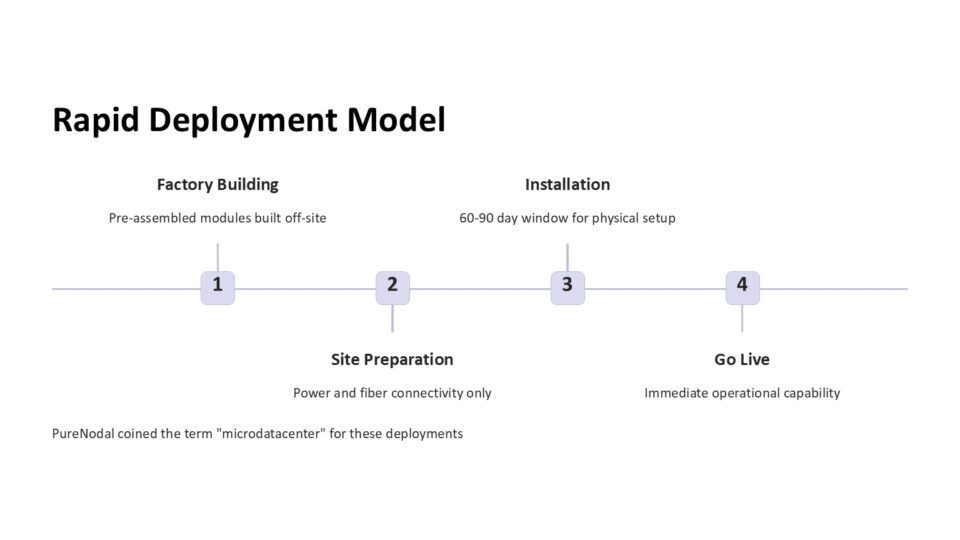
PureNodal’s approach brings together immersion cooling inside factory-built, pre-assembled blocks of modular data center modules that can be installed and go live in 60–90 days, once the site has power and fiber connectivity. Factory-based methodology bypasses the most time-consuming phases of traditional building and allows broadcasters and service providers to keep pace with market opportunities for capacity growth.
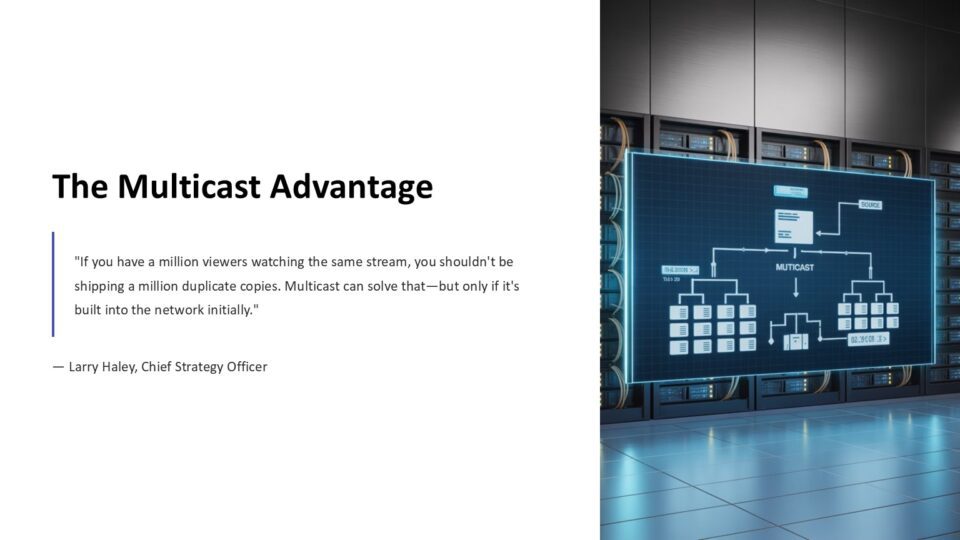
The facilities are deployed as nodes within a distributed network, with sub-15ms latency between locations. The architecture is designed to support edge computing—processing video, graphics, and AI workloads close to the audience for lowered latency and increased reliability. Native IP multicast integration is a differentiator for the broadcast market. Multicast allows live video streams to be delivered to many endpoints at once without duplicating bandwidth consumption. In PureNodal’s design, multicast is not layered on top of existing unicast infrastructure; multicast is built in, with the design done up front specifically for broadcast-quality reliability and size.
If you have a million viewers watching the same stream, you shouldn’t be shipping a million duplicate copies. Multicast can solve that—but only if it’s built into the network initially.
 Business Impact Across the Media Supply Chain
During production and post-production, PureNodal’s densely packed GPU-based environments can support AI upscaling, high-efficiency video coding, and SMPTE ST 2110 IP workflows without the power and cooling constraints of conventional facilities. Live encoding and 8K VVC transcoding are within cost, lowering per-channel costs and driving format adoption faster.
For play-out, especially in FAST channel operations, economics are radically different. Immersion-cooled nodes reduce OpEx per channel, allowing media companies to pilot more specialized or event-driven programming. Low-latency edge encoding also supports time-sensitive applications such as live sports betting and interactive streaming.
For delivery, PureNodal’s multicast-native infrastructure and edge compute capability can be employed as a mid-tier CDN layer to reduce backbone congestion and optimize content delivery performance. The same infrastructure can deliver non-video payloads—software updates, emergency alert messages, or IoT data—without consuming broadcast bandwidth using ATSC 3.0’s IP-native datacasting.
 Adoption Considerations
The 60–90 day installation window is only for physical installation and in-site commissioning of pre-fabricated modules. The game-changing part of this is that you can now take a data center to the power instead of waiting for all of the long lead-time infrastructure build-out to reach a typical large-scale project. PureNodal has coined the phrase microdatacenter for their deployments.
Operationally, immersion cooling requires retraining technical staff and ensuring hardware compatibility. Not all servers are immersion-capable, and some components can degrade in liquid in the long term. Vendor selection also enters the picture; with a lack of open standards, immersion solutions risk creating ecosystem lock-in. PureNodal’s “as-a-service” model reduces some of that risk by removing the hardware layer and delivering a cloud-like user experience.
 A Shift in Strategic Thinking
The decision to head toward immersion-cooled, modular infrastructure is not a technical one—it’s strategic. High-density compute synergy, reduced environment footprint, rapid deployment, and native multicast allow broadcasters to respond to market needs in real-time.
“The biggest hurdle to the uptake of immersion cooling isn’t tech—it’s inertia. It’s a mindset change in how data center teams think, how they work, and even what tools are in their toolbox.” — JD Jones, VP, Infrastructure Strategy of PureNodal.
PureNodal’s value proposition isn’t just that data centers are constructed in a hurry; it’s about rewriting where and how computing happens in the media pipeline. By aligning infrastructure capability with the operational imperative of modern TV, it offers a sustainable, scalable answer for an industry that can no longer afford to exist with legacy models.
Response to Next-Generation Media Production Challenges
Media infrastructure stands at a crossroads. The physics and economics of traditional air-cooled data centers cannot meet next-generation content creation and delivery demands. Immersion cooling and modular edge deployment present a technically and economically viable alternative.
PureNodal’s bundling of these strengths—with a network architecture built from the ground up designed especially to deliver multicast—provides broadcasters with a toolkit designed to meet their specific operational needs. It reduces deployment cycles, improves operational efficiency, and enables new business models previously constrained by infrastructure.
In the high-stakes world of live, high-res, and AI-created content, being able to place dense compute where and when it’s needed is no longer a nicety—it’s a competitive necessity. PureNodal teaches us how the industry can meet that challenge.