
 A look at how U.S. broadcast production is adapting as the audience shrinks, the money tightens, and the work still has to get done.
By Philip Grossman, Editor of TFT1957 | TV & Film Technology and broadcast technology veteran.
Portions of this article were published in TFT 1957 | TV & Film Technology Magazine, April 2026, Issue 792.
For most of my professional life, broadcast television has operated on a relatively reliable model: people showed up, advertisers showed up, and production groups were expected to deliver more, better, and technologically more sophisticated content every year. It wasn’t always beautiful, but at least it was comprehensible. In 2026, that model is not bending; it’s being broken.
The problem is not particularly complicated; the younger demo has moved to streaming, social media, and video platforms that don’t care much about channel position, appointment viewing, or the sentimental attachment many of us have to television. A twenty-five-year-old does not sit in front of a living room television set waiting for that 6:30 program to start, partially because of the large amounts of caffeinated energy drinks they consume, but also because their attention spans have been “tuned” for the new content paradigm. A twenty-five-year-old is watching highlights, clips, vertical video, and on-demand programming on whatever screen is at hand. Broadcast television did not lose viewers all at once; it has lost viewers in increments, and now it’s receiving the bill.
That matters because traditional advertising economics were built around broad reach and predictable scale. When the audience fragments, the ad dollars fragment with it, and the result is that many broadcasters are trying to fund a twentieth-century production structure with a twenty-first-century revenue curve, and this is why accountants develop facial tics.
Inside production departments, the response has not been panic so much as forced pragmatism. The mandate now is brutally simple: make content people still want, spend less money doing it, and stop pretending that yesterday’s workflow is sacred. This is not a creative trend piece. It is an operating model reset.
One of the biggest shifts is that productions are no longer being organized around hardware first. For years, broadcasters accumulated physical infrastructure the way old pilots accumulate flashlights or broadcast engineers accumulate small lengths of SDI cables just in case. Each one made sense at the time, and eventually, you realize you are carrying a lot of redundant weight. Many facilities still have control rooms, routers, switchers, and supporting gear that are well past their useful lives today. The issue is not that the equipment is old, but that old equipment tends to lock in old labor models, signal paths, maintenance costs, and assumptions about where people need to sit to get work done.
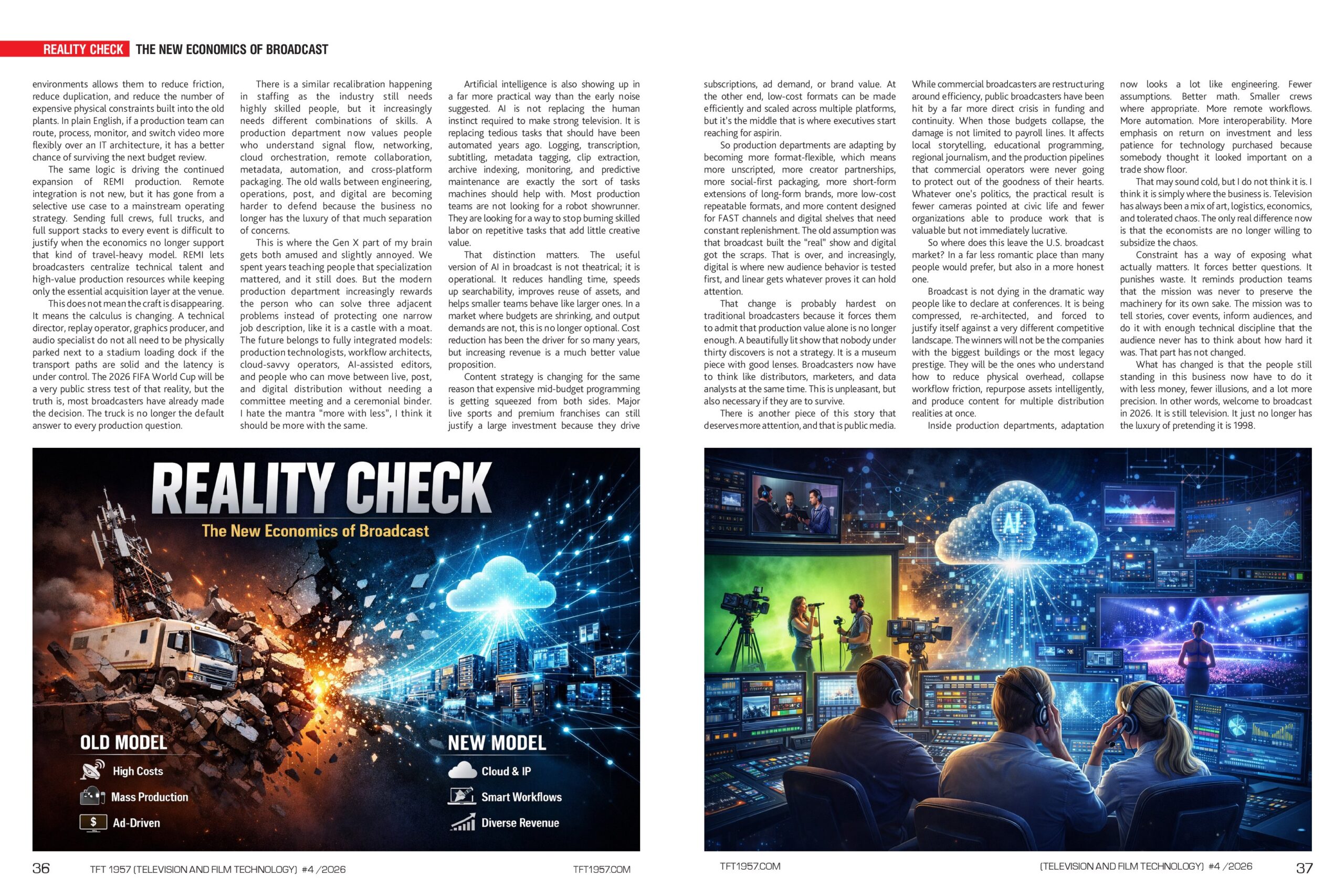 That is why IP and software-defined infrastructure have moved from industry talking points to operational necessity. Broadcasters are no longer modernizing because it looks good in a PowerPoint. They are modernizing because moving signals, control, and processing into IP environments allows them to reduce friction, reduce duplication, and reduce the number of expensive physical constraints built into the old plants. In plain English, if a production team can route, process, monitor, and switch video more flexibly over an IT architecture, it has a better chance of surviving the next budget review.
The same logic is driving the continued expansion of REMI production. Remote integration is not new, but it has gone from a selective use case to a mainstream operating strategy. Sending full crews, full trucks, and full support stacks to every event is difficult to justify when the economics no longer support that kind of travel-heavy model. REMI lets broadcasters centralize technical talent and high-value production resources while keeping only the essential acquisition layer at the venue.
This does not mean the craft is disappearing. It means the calculus is changing. A technical director, replay operator, graphics producer, and audio specialist do not all need to be physically parked next to a stadium loading dock if the transport paths are solid and the latency is under control. The 2026 FIFA World Cup will be a very public stress test of that reality, but the truth is, most broadcasters have already made the decision. The truck is no longer the default answer to every production question.
There is a similar recalibration happening in staffing as the industry still needs highly skilled people, but it increasingly needs different combinations of skills. A production department now values people who understand signal flow, networking, cloud orchestration, remote collaboration, metadata, automation, and cross-platform packaging. The old walls between engineering, operations, post, and digital are becoming harder to defend because the business no longer has the luxury of that much separation of concerns.
This is where the Gen X part of my brain gets both amused and slightly annoyed. We spent years teaching people that specialization mattered, and it still does. But the modern production department increasingly rewards the person who can solve three adjacent problems instead of protecting one narrow job description, like it is a castle with a moat. The future belongs to fully integrated models: production technologists, workflow architects, cloud-savvy operators, AI-assisted editors, and people who can move between live, post, and digital distribution without needing a committee meeting and a ceremonial binder. I hate the mantra “more with less”; I think it should be more with the same.
Artificial intelligence is also showing up in a far more practical way than the early noise suggested. AI is not replacing the human instinct required to make strong television. It is replacing tedious tasks that should have been automated years ago. Logging, transcription, subtitling, metadata tagging, clip extraction, archive indexing, monitoring, and predictive maintenance are exactly the sort of tasks machines should help with. Most production teams are not looking for a robot showrunner. They are looking for a way to stop burning skilled labor on repetitive tasks that add little creative value.
That distinction matters. The useful version of AI in broadcast is not theatrical; it is operational. It reduces handling time, improves searchability, enhances asset reuse, and helps smaller teams behave like larger ones. In a market where budgets are shrinking, and output demands are not, this is no longer optional. Cost reduction has been the driver for so many years, but increasing revenue is a much better value proposition.
Content strategy is changing for the same reason that expensive mid-budget programming is getting squeezed from both sides. Major live sports and premium franchises can still justify a large investment because they drive subscriptions, ad demand, or brand value. At the other end, low-cost formats can be made efficiently and scaled across multiple platforms, but it’s the middle that is where executives start reaching for aspirin.
So production departments are adapting by becoming more format-flexible, which means more unscripted, more creator partnerships, more social-first packaging, more short-form extensions of long-form brands, more low-cost repeatable formats, and more content designed for FAST channels and digital shelves that need constant replenishment. The old assumption was that broadcast built the “real” show and digital got the scraps. That is over, and increasingly, digital is where new audience behavior is tested first, and linear gets whatever proves it can hold attention.
That change is probably hardest on traditional broadcasters because it forces them to admit that production value alone is no longer enough. A beautifully lit show that nobody under thirty discovers is not a strategy. It is a museum piece with good lenses. Broadcasters now have to think like distributors, marketers, and data analysts at the same time. This is unpleasant, but also necessary if they are to survive.
There is another piece of this story that deserves more attention, and that is public media. While commercial broadcasters are restructuring around efficiency, public broadcasters have been hit by a far more direct crisis in funding and continuity. When those budgets collapse, the damage is not limited to payroll lines. It affects local storytelling, educational programming, regional journalism, and the production pipelines that commercial operators were never going to protect out of the goodness of their hearts. Whatever one’s politics, the practical result is fewer cameras pointed at civic life and fewer organizations able to produce work that is valuable but not immediately lucrative.
So where does this leave the U.S. broadcast market? In a far less romantic place than many people would prefer, but also in a more honest one.
Broadcast is not dying in the dramatic way people like to declare at conferences. It is being compressed, re-architected, and forced to justify itself against a very different competitive landscape. The winners will not be the companies with the biggest buildings or the most legacy prestige. They will be the ones who understand how to reduce physical overhead, collapse workflow friction, repurpose assets intelligently, and produce content for multiple distribution realities at once.
Inside production departments, adaptation now looks a lot like engineering. Fewer assumptions. Better math. Smaller crews where appropriate. More remote workflows. More automation. More interoperability. More emphasis on return on investment and less patience for technology purchased because somebody thought it looked important on a trade show floor.
That may sound cold, but I do not think it is. I think it is simply where the business is. Television has always been a mix of art, logistics, economics, and tolerated chaos. The only real difference now is that the economists are no longer willing to subsidize the chaos.
Constraint has a way of exposing what actually matters. It forces better questions. It punishes waste. It reminds production teams that the mission was never to preserve the machinery for its own sake. The mission was to tell stories, cover events, inform audiences, and do it with enough technical discipline that the audience never has to think about how hard it was. That part has not changed.
What has changed is that the people still standing in this business now have to do it with less money, fewer illusions, and a lot more precision. Welcome to the broadcast in 2026. It is still television. It just no longer has the luxury of pretending it is 1998.