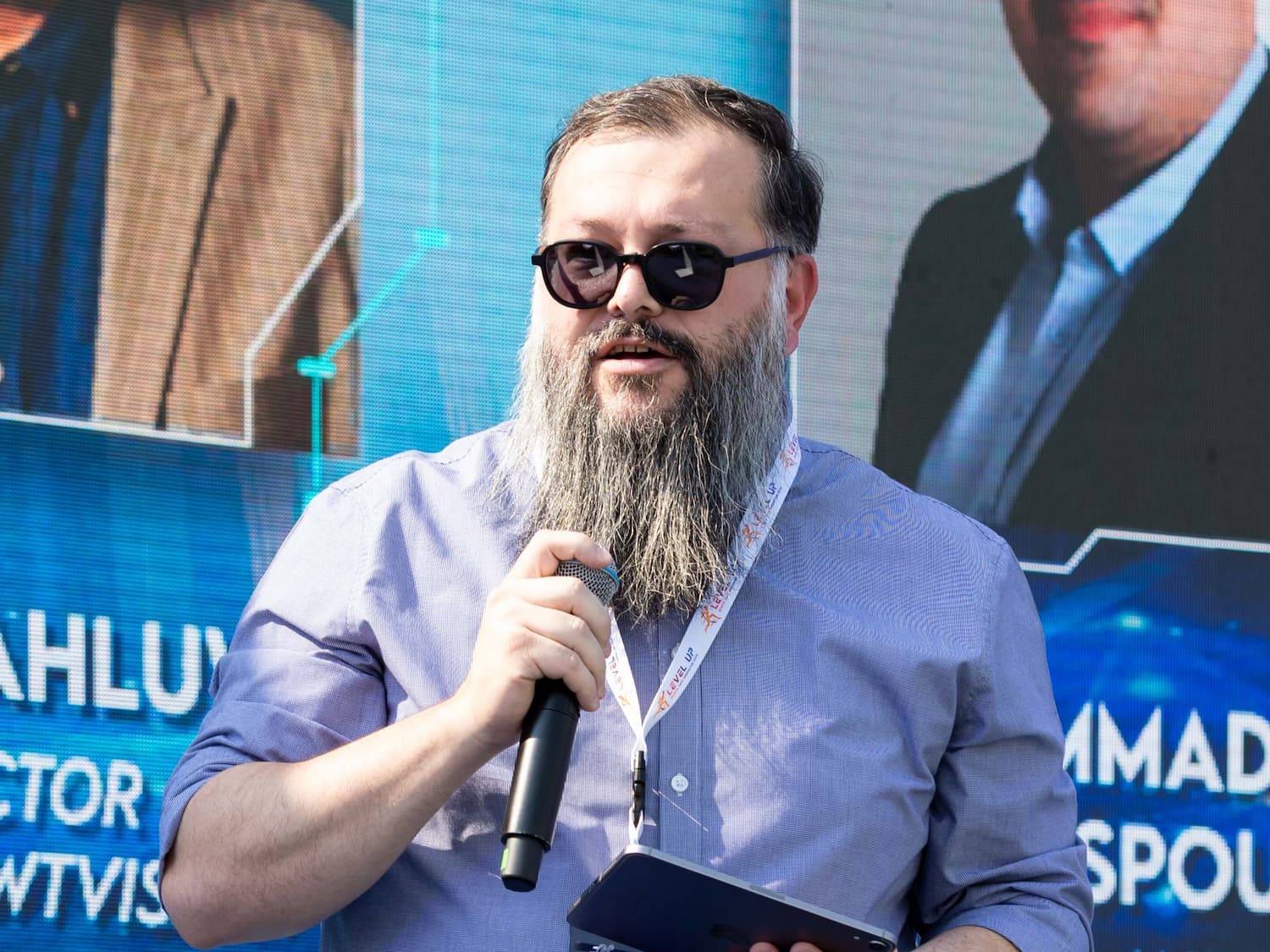
 Ammar Hina, a sports expert and Business Development Director at NEP Middle East & Asia, on why sports rights alone are no longer enough, why Gulf leagues want more control over their media, and how the entire sports broadcasting model is changing.
Gulf & MENA Decision-Makers Forum 2026 Brings Broadcast Leaders to Dubai
Sports broadcasting in the Gulf is changing fast. For years, the model was relatively straightforward: a league or federation sold the rights, a broadcaster showed the games, a production company handled the coverage, sponsors bought visibility, and the audience watched on television.
That model is no longer enough. Audiences are moving between TV, mobile, streaming, social media, gaming, vertical content, data, virtual reality, and other short-format videos. Rights are being split into more categories, and sponsors want more than logos around the pitch; they increasingly want to be more part of the product, not only the event itself.
Ammar Hina has watched this change from inside the industry, including through his work with the UAE Pro League and the Saudi Pro League, as well as his experience with many international and regional sports events. For him, the biggest shift is not simply technological. It is about who controls the sports product, who owns the relationship with the audience and understands audience habits, and where the real commercial value will come from in the future.
The Economics No Longer Work the Same Way
— How is the economics of sports broadcasting changing in the Gulf region? Are media rights becoming too expensive compared with the money broadcasters can make from them?
Through my experience in the GCC and MENA markets, I have seen this change directly. Viewer habits are different now. People are consuming more short-form content, more content on their phones, and more content through digital platforms, so the commercial model has to change as well.
In the past, a broadcaster could acquire a large package of rights and build its coverage around that. Today, the situation is much more fragmented. There can be separate linear rights, digital rights, streaming rights, regional or geographic zoning rights, data rights, and different rules around how that content can be used or where it can be used.
Football can still be an exception because of its scale and importance in most countries in the region, but in many sports the gap between the cost of the rights and the money you can make directly from those rights has become too wide. That means broadcasters cannot always treat sports as a standalone business that has to make a direct profit. Live sport can also be used to attract audiences into a wider ecosystem — a platform, a subscription service, a digital product, social media platforms, or a broader media offering.
Bahrain’s Yusuf Mohammed Buti Named Roundtable Moderator for Gulf & MENA Decision-Makers Forum 2026
And that changes production too. You are no longer producing one 16:9 television feed and saying the job is done. You need multiple outputs for multiple platforms and different types of audiences.
“The gap between rights costs and direct monetization is too wide.”
If You Control the Production, You Control the Product
— Are leagues and federations becoming more interested in producing and distributing their own content instead of handing everything over to broadcasters?
Absolutely. I saw this firsthand while developing broadcast departments for both the UAE Pro League and the Saudi Pro League.
Historically, leagues often gave broadcasters and production partners a lot of control. That could lead to differences in production quality, but there was another problem: the league itself had very little control over its audience and little ownership of fan data.
Today, rights holders are starting to understand that if you don’t control the world feed, you don’t really control your product. For me, that is a very important point. You need centralized production, clear technical standards, and a consistent world feed that represents the league properly when it is distributed internationally.
But today it goes beyond the main feed. You also need different formats for different platforms and different audiences. I do not think this means traditional television disappears; the near future is much more likely to be hybrid.
Sarkis Semaan, LBCI, to Participate in the Gulf & MENA Decision-Makers Forum 2026
A league can still license major live rights to broadcasters because broadcasters give you reach. But at the same time, the league can keep much more control over digital content, short-form video, international distribution, and first-party fan data.
“If you don’t control the world feed, you don’t control your product.”
A League Cannot Think Only About Matchday
— So are leagues effectively becoming media companies themselves?
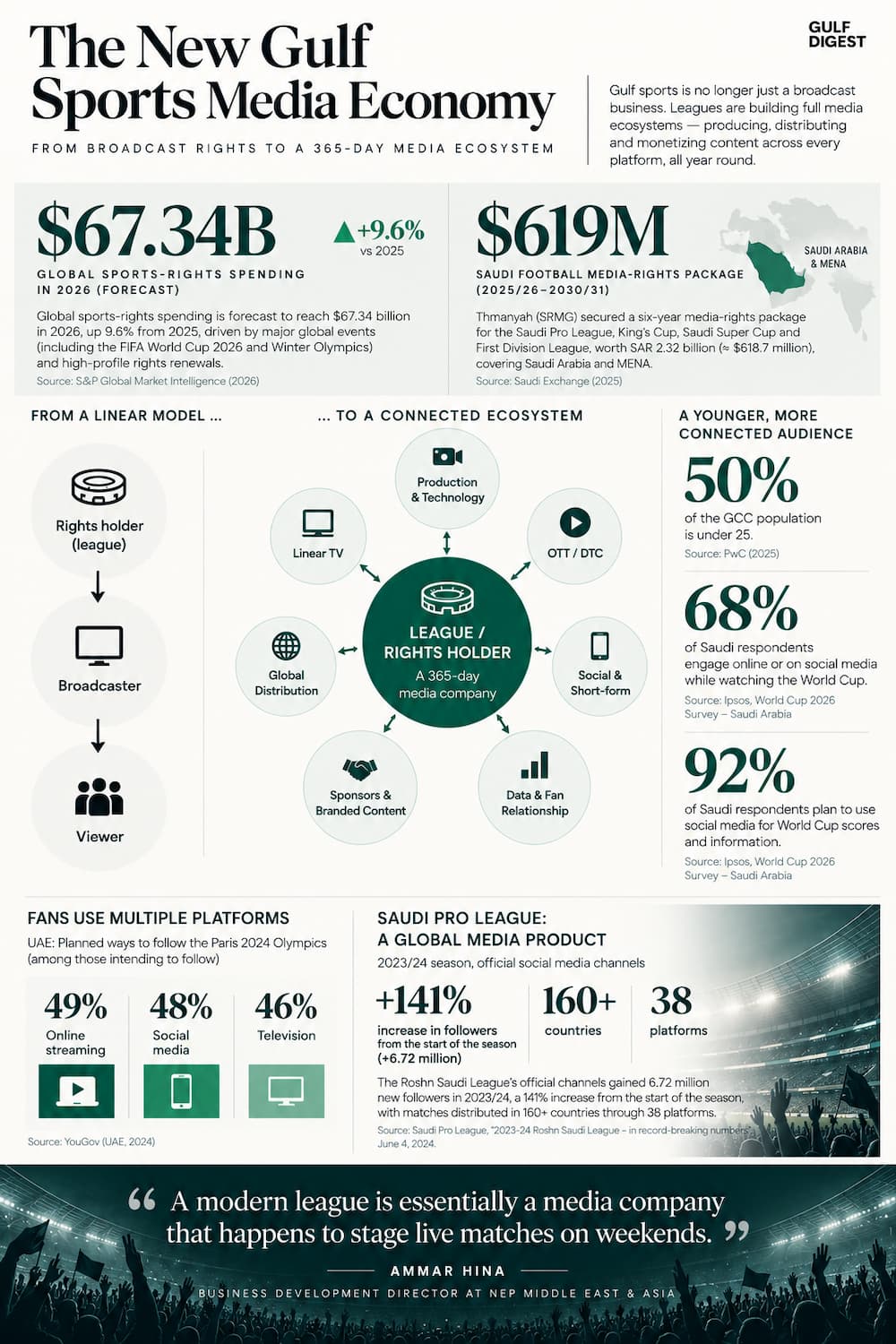
One hundred percent. A modern league is essentially a media company that happens to stage live matches on weekends. That is a very different way of thinking.
When I worked on structures such as the Saudi Pro League’s MediaHouse operation, the idea was exactly that: to move from being mainly an organizer of matches to becoming a media operation that works 365 days a year. You cannot communicate with fans only when the match starts. You need content every day.
That means having teams that can produce digital clips, horizontal and vertical video, localized content, different feeds, graphics, AR, and data-driven content. This is especially important when you are trying to connect with younger audiences.
wTVision Joins Gulf & MENA Decision-Makers Forum 2026 as Sponsor
Once a league controls that content pipeline, it creates more commercial opportunities. You are no longer completely dependent on one rights payment. You can create new sponsorship products, offer localized advertising, and build direct engagement with fans in different markets. Owning the content gives you more ways to create value from the audience.
“A modern league is essentially a media company that happens to stage live matches on weekends.”
Everyone’s Role Is Changing
— What does this mean for the relationship between leagues, broadcasters, production companies, sponsors, and digital platforms?
The old linear model — Rights Holder → Broadcaster → Consumer — cannot work in exactly the same way anymore. Everything is much more connected now.
Rights holders and broadcasters should increasingly think of each other as partners rather than simply as buyer and seller. They can work together on content, localization, distribution, and reaching different audiences.
The role of production companies is changing too. A company like NEP is no longer there simply to provide an OB van and the technical facilities for a match. Production and technology partners are increasingly involved in remote production, AI workflows, scalable technology, and finding ways to produce more content without simply increasing costs at the same rate.
Sponsors are changing as well. They don’t just want their logo on an LED board or behind football stars at a press conference. They want digital inventory, data, branded content, and integrations on air and on social media.
NEP Middle East & Asia to Host Inaugural Gulf & MENA Decision-Makers Forum in Dubai
Digital platforms cannot be treated as something you think about at the end either. OTT platforms, YouTube, TikTok, regional apps — all of these need to be part of the rights and distribution discussion from the beginning, especially if you want younger audiences.
So the whole structure is changing. The league is becoming a media owner, the broadcaster more of a distribution partner, and the production company a technology and workflow partner. Sponsors want to become part of the content, while digital platforms are becoming part of the core strategy rather than an extra channel.
That is where I think the GCC and MENA sports market is moving.
“The traditional linear value chain — Rights Holder → Broadcaster → Consumer — cannot work in the same way anymore.”
Ammar Hina Appointed Strategic Chair of The Gulf & MENA Decision-Makers Forum 2026