

 The real question is not whether AI is coming to film and television. It is whether we are smart enough to put it where it helps, keep it away from where it hurts, and remember that technical innovation does not guarantee a better result.
This article was published in TFT1957 | TV & Film Technology Magazine, April 2026, Issue 792.
By Philip Grossman
I have always enjoyed our industry because it is the perfect intersection of art and science. It is one of the rare industries where a director can ask the impossible, and an engineer is expected to deliver it on time, in sync, without setting fire to the budget. This is what has always made the film and television business interesting to me. This is why the current AI discussion is more important than most of the noise being thrown around the NAB and IBC shows.
Multiple Transitions, One Industry
Last year, I wrote about how our industry was being forced to digest a stack of multiple transitions all at once. It included the move from purpose-built hardware to COTS infrastructure, the move from SDI to IP, the growth of cloud workflows, the expansion of OTT, and the long march into UHD, HDR, and Rec. 2020. None of those shifts happened in a vacuum, and none of them arrived with the courtesy of time while we figured them out.
The broadcasters, studios, and production companies still need to deliver content, maintain profitability, and keep the system operational, all while the ground is still moving under our feet. The AI discussion is larger than just the signal chain, larger than just the machine room. We are no longer just discussing where our content is, where it is going, or even how it is moving. We are discussing what is happening to our content, who is doing that, what is being automated, what is being assisted, what is being created, and ultimately, what is happening to our bottom line.
Where AI Actually Adds Value
AI is involved in everything from signal monitoring, live production, editing, discovery, localization, metadata, ad sales, targeting, and monetization. This is why this is not just another technology cycle or another technology investment. This is an investment that is impacting everything from engineering to operations to our bottom line.
The first thing we need to do is filter out the useful from the nonsense. A great deal of what is being passed off as AI in our business these days is not a digital chief engineer or some kind of tireless 24/7 production brain. It is machine learning, pattern recognition, and automation applied to the work that nobody really wants to do because it’s repetitive, manual, slow, and expensive. This is why it first showed up in speech-to-text, translation, captioning, metadata extraction, content search, QC, etc.
Filtering Hype from Reality
This is usually the way that new technology makes its grand entrance in our business. It has a great deal of hype, a great many promises, and a familiar underlying assumption that immediate adoption is the only way to remain relevant. In fact, most of these promises are never delivered in quite the way it was first promised. The companies that end up succeeding are not always the first adopters; they’re the ones that manage to filter out the noise from the useful and actually apply it in a way that saves them time or improves their results.
That distinction is important because it is the point at which the industry begins to differentiate between value and marketing hype. Organizations like SMPTE and the EBU are all signaling this shift in attitude. Real media organizations are less interested in speeches about how AI is going to change everything than they are in whether or not it is going to help them solve problems. This is where the value is, and it is most useful when it removes barriers from the workflow rather than adding another layer of uncertainty. And, as so often happens, the first place that value is earned is not necessarily the sexy place. It is the place where the business runs a little easier, a little more efficiently. It may not be sexy, but it is often where the return on the investment first becomes evident.
What makes this a particularly interesting time, however, is that not only is the technology changing, but the business itself is starting to change as well. We’ve always known our business as a fairly linear concept, whether the topic was signal flow, post-production, distribution, or monetization. However, with the implementation of AI, the business is also starting to change.
 AI Across the Entire Workflow
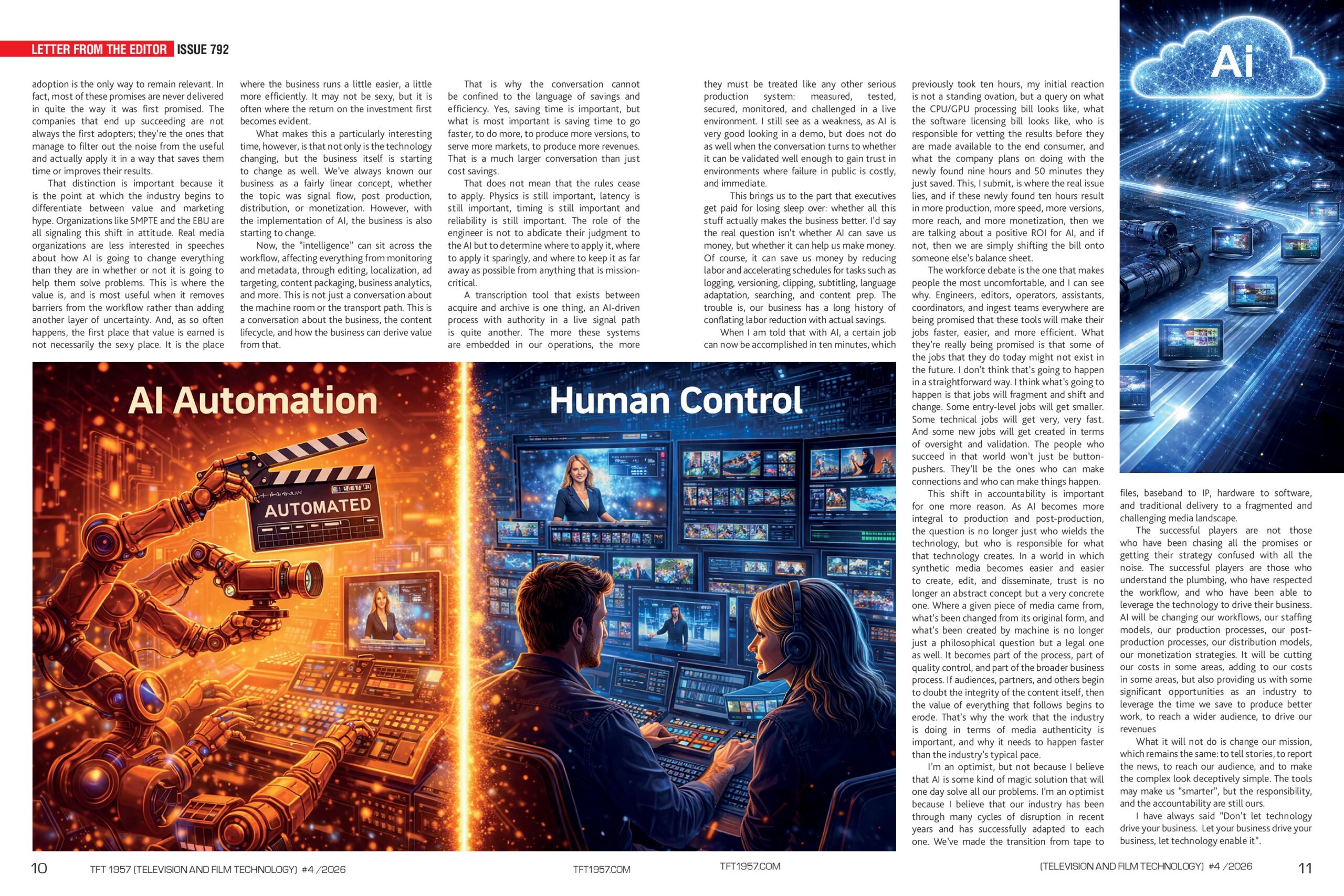
Now, the “intelligence” can sit across the workflow, affecting everything from monitoring and metadata, through editing, localization, ad targeting, content packaging, business analytics, and more. This is not just a conversation about the machine room or the transport path. This is a conversation about the business, the content lifecycle, and how the business can derive value from that.
That is why the conversation cannot be confined to the language of savings and efficiency. Yes, saving time is important, but what is most important is saving time to go faster, to do more, to produce more versions, to serve more markets, to produce more revenues. That is a much larger conversation than just cost savings.
Engineering Still Matters
That does not mean that the rules cease to apply. Physics is still important, latency is still important, timing is still important, and reliability is still important. The role of the engineer is not to abdicate their judgment to the AI but to determine where to apply it, where to apply it sparingly, and where to keep it as far away as possible from anything mission-critical.
A transcription tool that exists between acquire and archive is one thing; an AI-driven process with authority in a live signal path is quite another. The more these systems are embedded in our operations, the more they must be treated like any other serious production system: measured, tested, secured, monitored, and challenged in a live environment. I still see it as a weakness, as AI is very good looking in a demo, but does not do as well when the conversation turns to whether it can be validated well enough to gain trust in environments where failure in public is costly and immediate.
ROI: Cost Saving vs Revenue Growth
This brings us to the part that executives get paid for losing sleep over: whether all this stuff actually makes the business better. I’d say the real question isn’t whether AI can save us money, but whether it can help us make money. Of course, it can save us money by reducing labor and accelerating schedules for tasks such as logging, versioning, clipping, subtitling, language adaptation, searching, and content prep. The trouble is, our business has a long history of conflating labor reduction with actual savings.
When I am told that with AI, a certain job can now be accomplished in ten minutes, which previously took ten hours, my initial reaction is not a standing ovation, but a query on what the CPU/GPU processing bill looks like, what the software licensing bill looks like, who is responsible for vetting the results before they are made available to the end consumer, and what the company plans on doing with the newly found nine hours and 50 minutes they just saved. This, I submit, is where the real issue lies, and if these newly found ten hours result in more production, more speed, more versions, more reach, and more monetization, then we are talking about a positive ROI for AI, and if not, then we are simply shifting the bill onto someone else’s balance sheet.
The Workforce Shift
The workforce debate is the one that makes people the most uncomfortable, and I can see why. Engineers, editors, operators, assistants, coordinators, and ingest teams everywhere are being promised that these tools will make their jobs faster, easier, and more efficient. What they’re really being promised is that some of the jobs that they do today might not exist in the future. I don’t think that’s going to happen straightforwardly. I think what’s going to happen is that jobs will fragment and shift, and change. Some entry-level jobs will get smaller. Some technical jobs will get very, very fast. And some new jobs will be created in terms of oversight and validation. The people who succeed in that world won’t just be button-pushers. They’ll be the ones who can make connections and who can make things happen.
This shift in accountability is important for one more reason. As AI becomes more integral to production and post-production, the question is no longer just who wields the technology, but who is responsible for what that technology creates. In a world in which synthetic media becomes easier and easier to create, edit, and disseminate, trust is no longer an abstract concept but a very concrete one. Where a given piece of media came from, what’s been changed from its original form, and what’s been created by machine is no longer just a philosophical question but a legal one as well. It becomes part of the process, part of quality control, and part of the broader business process. If audiences, partners, and others begin to doubt the integrity of the content itself, then the value of everything that follows begins to erode. That’s why the work that the industry is doing in terms of media authenticity is important, and why it needs to happen faster than the industry’s typical pace.
Adapting to Another Disruption Cycle
I’m an optimist, but not because I believe that AI is some kind of magic solution that will one day solve all our problems. I’m an optimist because I believe that our industry has been through many cycles of disruption in recent years and has successfully adapted to each one. We’ve made the transition from tape to files, baseband to IP, hardware to software, and traditional delivery to a fragmented and challenging media landscape.
The successful players are not those who have been chasing all the promises or getting their strategy confused with all the noise. The successful players are those who understand the plumbing, who have respected the workflow, and who have been able to leverage the technology to drive their business. AI will be changing our workflows, our staffing models, our production processes, our post-production processes, our distribution models, and our monetization strategies. It will be cutting our costs in some areas, adding to our costs in some areas, but also providing us with some significant opportunities as an industry to leverage the time we save to produce better work, to reach a wider audience, to drive our revenues
What it will not do is change our mission, which remains the same: to tell stories, to report the news, to reach our audience, and to make the complex look deceptively simple. The tools may make us “smarter”, but the responsibility and the accountability are still ours.
I have always said, “Don’t let technology drive your business. Let your business drive your business, let technology enable it”.
https://tkt1957.com/tft1957-tv-film-tech-magazine-special-edition-for-nab-show-2026