
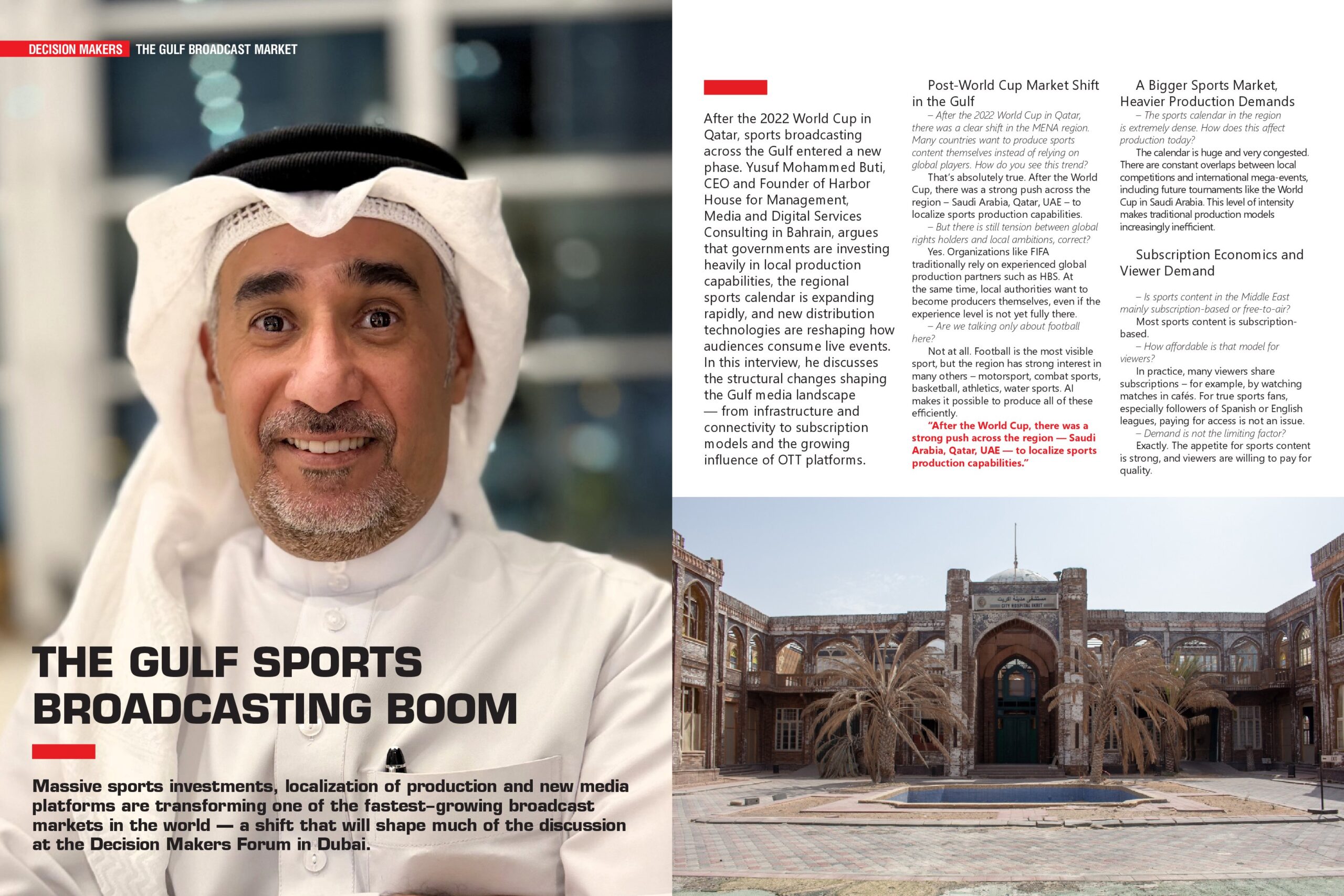
 After the 2022 World Cup in Qatar, sports broadcasting across the Gulf entered a new phase. Yusuf Mohammed Buti, CEO and Founder of Harbor House for Management, Media and Digital Services Consulting in Bahrain, argues that governments are investing heavily in local production capabilities, the regional sports calendar is expanding rapidly, and new distribution technologies are reshaping how audiences consume live events.
In this interview, he discusses the structural changes shaping the Gulf media landscape — from infrastructure and connectivity to subscription models and the growing influence of OTT platforms.
This article was published in TFT1957 | TV & Film Technology Magazine, April 2026, Issue 792.
Post-World Cup Market Shift in the Gulf
– After the 2022 World Cup in Qatar, there was a clear shift in the MENA region. Many countries want to produce sports content themselves instead of relying on global players. How do you see this trend?
That’s absolutely true. After the World Cup, there was a strong push across the region — Saudi Arabia, Qatar, UAE — to localize sports production capabilities.
– But there is still tension between global rights holders and local ambitions, correct?
Yes. Organizations like FIFA traditionally rely on experienced global production partners such as HBS. At the same time, local authorities want to become producers themselves, even if the experience level is not yet fully there.
– Are we talking only about football here?
Not at all. Football is the most visible sport, but the region has a strong interest in many others — motorsport, combat sports, basketball, athletics, and water sports. AI makes it possible to produce all of these efficiently.
“After the World Cup, there was a strong push across the region — Saudi Arabia, Qatar, UAE — to localize sports production capabilities.”
A Bigger Sports Market, Heavier Production Demands
– The sports calendar in the region is extremely dense. How does this affect production today?
The calendar is huge and very congested. There are constant overlaps between local competitions and international mega-events, including future tournaments like the World Cup in Saudi Arabia. This level of intensity makes traditional production models increasingly inefficient.
 Subscription Economics and Viewer Demand
– Is sports content in the Middle East mainly subscription-based or free-to-air?
Most sports content is subscription-based.
– How affordable is that model for viewers?
In practice, many viewers share subscriptions — for example, by watching matches in cafés. For true sports fans, especially followers of Spanish or English leagues, paying for access is not an issue.
– Demand is not the limiting factor?
Exactly. The appetite for sports content is strong, and viewers are willing to pay for quality.
“Most sports content is subscription-based.”
Distribution Challenges Across the Gulf
– When delivering content to both local audiences and the global diaspora, what are the biggest technical and operational challenges?
The main challenge is building reliable, multi-platform distribution and contribution workflows that can handle both mega-events and fast-paced digital content.
– Does this challenge vary by country in the region?
Yes. Countries like Bahrain, Qatar, and the UAE are relatively easier to manage from an infrastructure perspective compared to Saudi Arabia.
– Why is Saudi Arabia more complex?
The scale is different — geographically, operationally, and in terms of event volume. That requires a more robust and carefully designed distribution architecture.
Connectivity as Market Infrastructure
– What role does connectivity play in live sports production across the Gulf region?
Connectivity is a key factor. In countries like Qatar, Bahrain, and Abu Dhabi — and the UAE in general — fiber penetration is close to 98 percent. That means from almost any stadium, you can transmit a high-quality signal without major issues.
“In countries like Qatar, Bahrain, and Abu Dhabi — and the UAE in general — fiber penetration is close to 98 percent.”
Hybrid Distribution and the Next Phase of Connectivity
– Can you explain how these hybrid hubs operate in real production scenarios?
Signals are sent via satellite to a hub. From that hub, distribution happens internationally over fiber. Today, this approach is still relatively costly, but costs are gradually decreasing.
– What impact will new satellite constellations have on future sports distribution models?
With new-generation satellites from companies like SpaceX and upcoming fleets from Amazon, connectivity becomes far more flexible. This will significantly improve both national and international distribution of live sports.
Viewer Access, Inequality, and Piracy Beyond the GCC
– From the viewer’s perspective, are there connectivity issues today?
For viewers in the Gulf, not really. Most people have at least 5G connectivity. Watching sports via IP or streaming has become standard and affordable.
– Does this change outside the GCC (Gulf Cooperation Council) region?
Yes. If you move beyond the Gulf — for example, into parts of Africa or other regions — connectivity becomes a real challenge. Data access may be limited, streaming may not be affordable, and satellite subscriptions are often out of reach.
– What happens in such markets?
This is where piracy emerges. Content gets redistributed through social media accounts, IPTV (Internet Protocol Television) services, or other IP-based channels operating across borders.
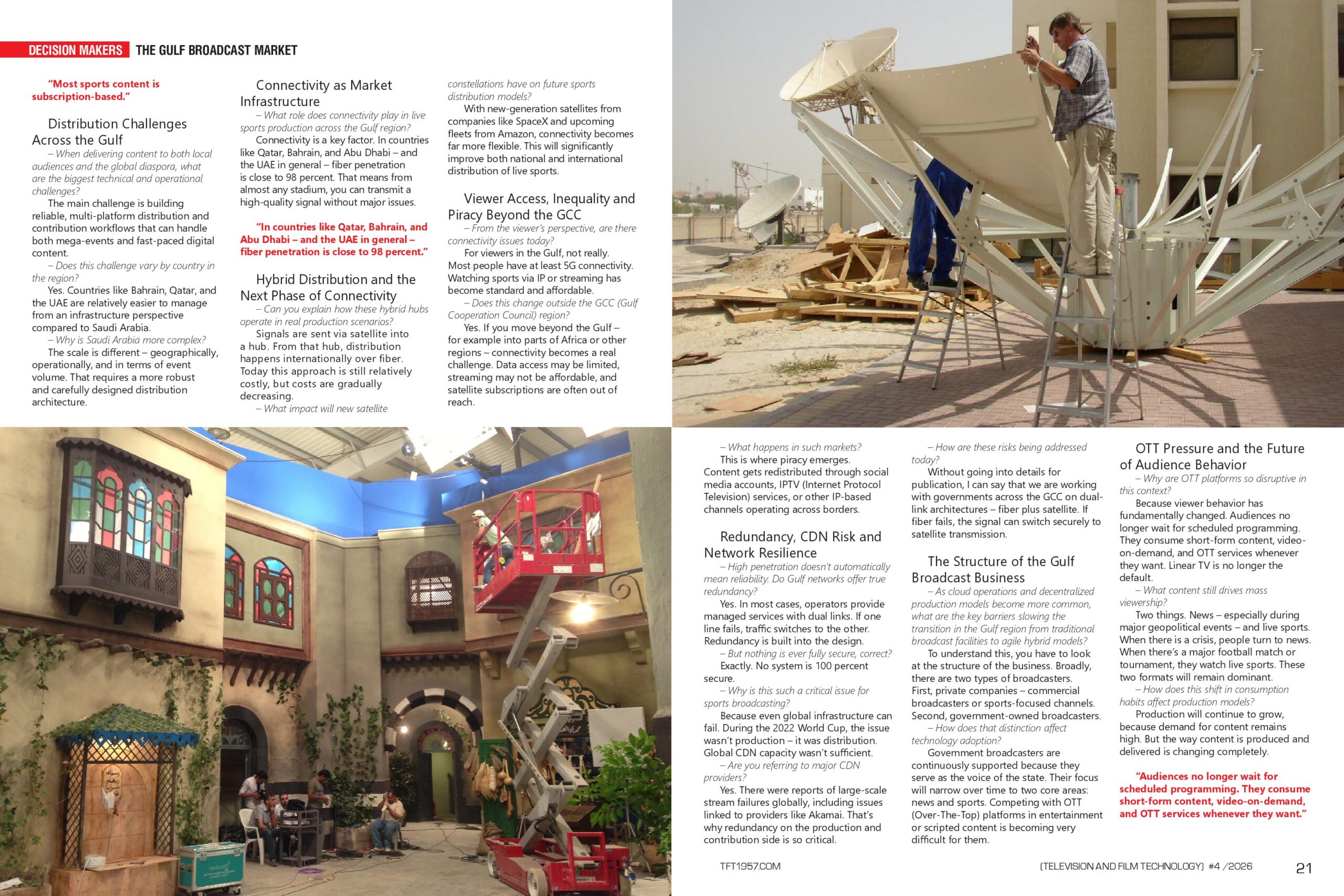
From Bahrain to Building Media Cities: The Journey of Yusuf Mohammed Buti
Redundancy, CDN Risk, and Network Resilience
– High penetration doesn’t automatically mean reliability. Do Gulf networks offer true redundancy?
Yes. In most cases, operators provide managed services with dual links. If one line fails, traffic switches to the other. Redundancy is built into the design.
– But nothing is ever fully secure, correct?
Exactly. No system is 100 percent secure.
– Why is this such a critical issue for sports broadcasting?
Because even global infrastructure can fail, during the 2022 World Cup, the issue wasn’t production — it was distribution. Global CDN capacity wasn’t sufficient.
– Are you referring to major CDN providers?
Yes. There were reports of large-scale stream failures globally, including issues linked to providers like Akamai. That’s why redundancy on the production and contribution side is so critical.
– How are these risks being addressed today?
Without going into details for publication, I can say that we are working with governments across the GCC on dual-link architectures — fiber plus satellite. If fiber fails, the signal can switch securely to satellite transmission.
The Structure of the Gulf Broadcast Business
– As cloud operations and decentralized production models become more common, what are the key barriers in the Gulf region? What is slowing the shift from traditional broadcast facilities to agile hybrid models?
To understand this, you need to look at the business’s structure. Broadly, there are two types of broadcasters. First, private companies — commercial broadcasters or sports-focused channels. Second, government-owned broadcasters.
– How does that distinction affect technology adoption?
Government broadcasters are continuously supported because they serve as the voice of the state. Their focus will narrow over time to two core areas: news and sports. Competing with OTT (Over-The-Top) platforms in entertainment or scripted content is becoming very difficult for them.
OTT Pressure and the Future of Audience Behavior
– Why are OTT platforms so disruptive in this context?
Because viewer behavior has fundamentally changed. Audiences no longer wait for scheduled programming. They consume short-form content, video-on-demand, and OTT services whenever they want. Linear TV is no longer the default.
– What content still drives mass viewership?
Two things. News — especially during major geopolitical events — and live sports. When there is a crisis, people turn to the news. When there’s a major football match or tournament, they watch live sports. These two formats will remain dominant.
“Audiences no longer wait for scheduled programming. They consume short-form content, video-on-demand, and OTT services whenever they want.”
– How does this shift in consumption habits affect production models?
Production will continue to grow because demand for content remains high. But the way content is produced and delivered is changing completely.
TFT1957 | TV & Film Tech Magazine Special Edition for NAB Show 2026