
John Mailhot, Senior Vice President, Product Management, at Imagine Communications, explains why orchestration is becoming a core operational layer in modern broadcast. As control rooms move toward IP-connected, software-based workflows, the piece examines how orchestration helps broadcasters manage complexity. It also looks at how orchestration aligns infrastructure with automation. In addition, it shows how orchestration supports hybrid operations, regional variants, and dynamic channel deployment.
This article was published in TFT1957 | TV & Film Technology Magazine, April 2026, Issue 792.
As broadcast control rooms evolve to support dozens of outbound channels, live event cut-ins, digital streams, and regional variants, the underlying infrastructure has become both more powerful and more complex. The shift from fixed, hardware-defined air chains to IP-connected, software-based workflows is transforming how facilities ingest, process, and play out content. At the center of this transformation is orchestration.
For broadcasters navigating hybrid environments and rising audience expectations, orchestration is no longer an abstract IT concept. It is fast becoming an operational necessity.
From Fixed Air Chains to Fluid Workflows
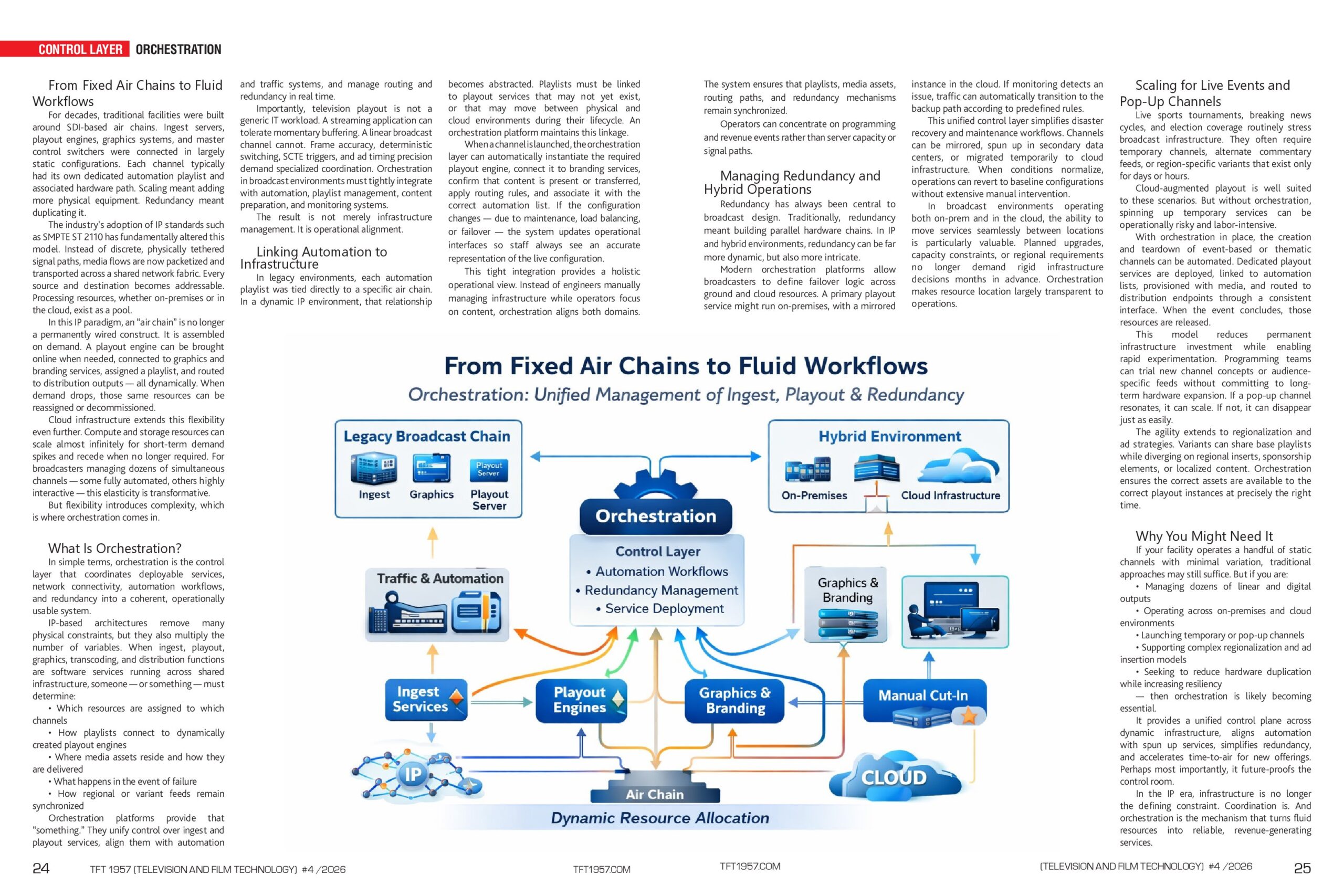
For decades, traditional facilities were built around SDI-based air chains. Ingest servers, playout engines, graphics systems, and master control switchers were connected in largely static configurations. Each channel typically had its own dedicated automation playlist and associated hardware path. Scaling meant adding more physical equipment. Redundancy meant duplicating it.
The industry’s adoption of IP standards such as SMPTE ST 2110 has fundamentally altered this model. Instead of discrete, physically tethered signal paths, media flows are now packetized and transported across a shared network fabric. Every source and destination becomes addressable. Processing resources, whether on-premises or in the cloud, exist as a pool.
In this IP paradigm, an “air chain” is no longer a permanently wired construct. It is assembled on demand. A playout engine can be brought online when needed, connected to graphics and branding services, assigned a playlist, and routed to distribution outputs — all dynamically. When demand drops, those same resources can be reassigned or decommissioned.
Cloud infrastructure extends this flexibility even further. Compute and storage resources can scale almost infinitely for short-term demand spikes and recede when no longer required. For broadcasters managing dozens of simultaneous channels — some fully automated, others highly interactive — this elasticity is transformative.
But flexibility introduces complexity, which is where orchestration comes in.
What Is Orchestration?
In simple terms, orchestration is the control layer that coordinates deployable services, network connectivity, automation workflows, and redundancy into a coherent, operationally usable system.
IP-based architectures remove many physical constraints, but they also multiply the number of variables. When ingest, playout, graphics, transcoding, and distribution functions are software services running across shared infrastructure, someone — or something — must determine:
- Which resources are assigned to which channels?
- How do playlists connect to dynamically created playout engines?
- Where media assets reside and how they are delivered?
- What happens in the event of failure?
- How do regional or variant feeds remain synchronized?
Orchestration platforms provide that “something.” They unify control over ingest and playout services, align them with automation and traffic systems, and manage routing and redundancy in real time.
Importantly, television playout is not a generic IT workload. A streaming application can tolerate momentary buffering. A linear broadcast channel cannot. Frame accuracy, deterministic switching, SCTE triggers, and ad timing precision demand specialized coordination. Orchestration in broadcast environments must tightly integrate with automation, playlist management, content preparation, and monitoring systems.
The result is not merely infrastructure management. It is operational alignment.
Linking Automation to Infrastructure
In legacy environments, each automation playlist was tied directly to a specific air chain. In a dynamic IP environment, that relationship becomes abstracted. Playlists must be linked to playout services that may not yet exist, or that may move between physical and cloud environments during their lifecycle. An orchestration platform maintains this linkage.
When a channel is launched, the orchestration layer can automatically instantiate the required playout engine, connect it to branding services, confirm that content is present or transferred, apply routing rules, and associate it with the correct automation list. If the configuration changes — due to maintenance, load balancing, or failover — the system updates operational interfaces so staff always see an accurate representation of the live configuration.
This tight integration provides a holistic operational view. Instead of engineers manually managing infrastructure while operators focus on content, orchestration aligns both domains. The system ensures that playlists, media assets, routing paths, and redundancy mechanisms remain synchronized.
Operators can concentrate on programming and revenue events rather than server capacity or signal paths.
 Managing Redundancy and Hybrid Operations
Redundancy has always been central to broadcast design. Traditionally, redundancy meant building parallel hardware chains. In IP and hybrid environments, redundancy can be far more dynamic, but also more intricate.
Modern orchestration platforms allow broadcasters to define failover logic across ground and cloud resources. A primary playout service might run on-premises, with a mirrored instance in the cloud. If monitoring detects an issue, traffic can automatically transition to the backup path according to predefined rules.
This unified control layer simplifies disaster recovery and maintenance workflows. Channels can be mirrored, spun up in secondary data centers, or migrated temporarily to cloud infrastructure. When conditions normalize, operations can revert to baseline configurations without extensive manual intervention.
In broadcast environments operating both on-prem and in the cloud, the ability to move services seamlessly between locations is particularly valuable. Planned upgrades, capacity constraints, or regional requirements no longer demand rigid infrastructure decisions months in advance. Orchestration makes resource location largely transparent to operations.
TFT1957 | TV & Film Tech Magazine Special Edition for NAB Show 2026
Scaling for Live Events and Pop-Up Channels
Live sports tournaments, breaking news cycles, and election coverage routinely stress broadcast infrastructure. They often require temporary channels, alternate commentary feeds, or region-specific variants that exist only for days or hours.
Cloud-augmented playout is well-suited to these scenarios. But without orchestration, spinning up temporary services can be operationally risky and labor-intensive.
With orchestration in place, the creation and teardown of event-based or thematic channels can be automated. Dedicated playout services are deployed, linked to automation lists, provisioned with media, and routed to distribution endpoints through a consistent interface. When the event concludes, those resources are released.
This model reduces permanent infrastructure investment while enabling rapid experimentation. Programming teams can trial new channel concepts or audience-specific feeds without committing to long-term hardware expansion. If a pop-up channel resonates, it can scale. If not, it can disappear just as easily.
The agility extends to regionalization and ad strategies. Variants can share base playlists while diverging on regional inserts, sponsorship elements, or localized content. Orchestration ensures the correct assets are available to the correct playout instances at precisely the right time.
https://tkt1957.com/tft1957-tv-film-tech-magazine-special-edition-for-nab-show-2026
Why You Might Need It
If your facility operates a handful of static channels with minimal variation, traditional approaches may still suffice. But if you are:
- Managing dozens of linear and digital outputs.
- Operating across on-premises and cloud environments.
- Launching temporary or pop-up channels.
- Supporting complex regionalization and ad insertion models.
- Seeking to reduce hardware duplication while increasing resiliency.
— then orchestration is likely becoming essential.
It provides a unified control plane across dynamic infrastructure, aligns automation with spun-up services, simplifies redundancy, and accelerates time-to-air for new offerings. Perhaps most importantly, it future-proofs the control room.
In the IP era, infrastructure is no longer the defining constraint. Coordination is. And orchestration is the mechanism that turns fluid resources into reliable, revenue-generating services.
Imagine Communications: John Mailhot Awarded 2024 David Sarnoff Medal