Originally published in TFT1957 | TV & Film Technology Magazine, April 2026, Issue 792.
By Philip Grossman, Editor-in-Chief, TFT1957 | TV & Film Tech Magazine
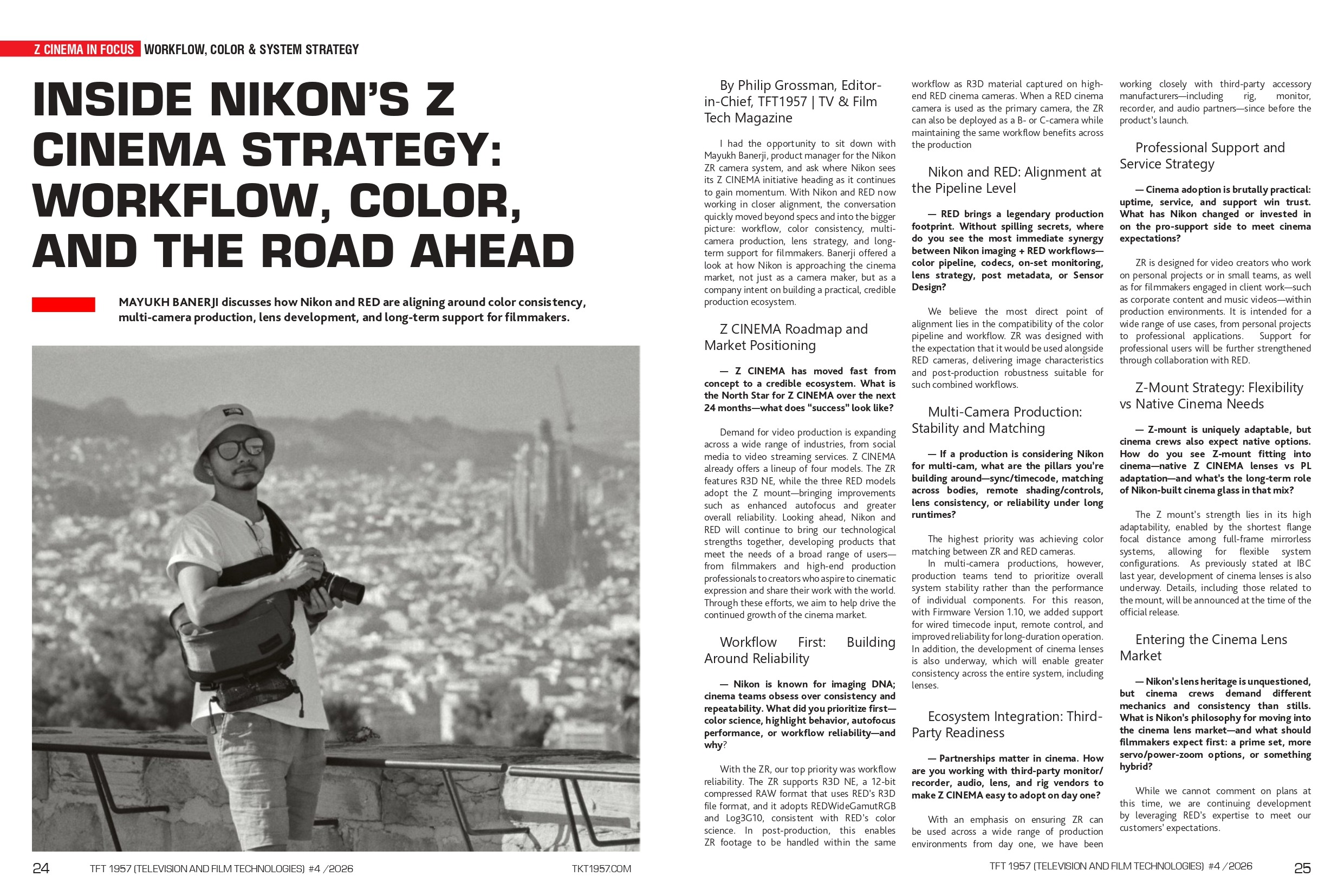
I had the opportunity to sit down with Mayukh Banerji, product manager for the Nikon ZR camera system, and ask where Nikon sees its Z CINEMA initiative heading as it continues to gain momentum. With Nikon and RED now working more closely, the conversation quickly moved beyond specs to the bigger picture: workflow, color consistency, multi-camera production, lens strategy, and long-term support for filmmakers. Banerji offered a look at how Nikon is approaching the cinema market, not just as a camera maker, but as a company intent on building a practical, credible production ecosystem.
Z CINEMA Roadmap and Market Positioning
– Z CINEMA has moved fast from concept to a credible ecosystem. What is the North Star for Z CINEMA over the next 24 months—what does “success” look like?
Demand for video production is expanding across a wide range of industries, from social media to video streaming services. Z CINEMA already offers a lineup of four models. The ZR features R3D NE, while the three RED models adopt the Z mount—bringing improvements such as enhanced autofocus and greater overall reliability. Looking ahead, Nikon and RED will continue to bring our technological strengths together, developing products that meet the needs of a broad range of users—from filmmakers and high-end production professionals to creators who aspire to cinematic expression and share their work with the world. Through these efforts, we aim to help drive the continued growth of the cinema market.
Workflow First: Building Around Reliability
– Nikon is known for imaging DNA; cinema teams obsess over consistency and repeatability. What did you prioritize first—color science, highlight behavior, autofocus performance, or workflow reliability—and why?
With the ZR, our top priority was workflow reliability. The ZR supports R3D NE, a 12-bit compressed RAW format based on RED’s R3D file format, and adopts REDWideGamutRGB and Log3G10, consistent with RED’s color science. In post-production, this enables ZR footage to be handled within the same workflow as R3D material captured on high-end RED cinema cameras. When a RED cinema camera is used as the primary camera, the ZR can also be deployed as a B- or C-camera while maintaining the same workflow benefits across the production.
Nikon and RED: Alignment at the Pipeline Level
– RED brings a legendary production footprint. Without spilling secrets, where do you see the most immediate synergy between Nikon imaging + RED workflows—color pipeline, codecs, on-set monitoring, lens strategy, post metadata, or Sensor Design?
We believe the most direct point of alignment lies in the compatibility of the color pipeline and workflow. ZR was designed with the expectation that it would be used alongside RED cameras, delivering image characteristics and post-production robustness suitable for such combined workflows.
Multi-Camera Production: Stability and Matching
– If a production is considering Nikon for multi-cam, what are the pillars you’re building around—sync/timecode, matching across bodies, remote shading/controls, lens consistency, or reliability under long runtimes?
The highest priority was achieving color matching between ZR and RED cameras.
In multi-camera productions, however, production teams tend to prioritize overall system stability rather than the performance of individual components. For this reason, with Firmware Version 1.10, we added support for wired timecode input, remote control, and improved reliability for long-duration operation. In addition, the development of cinema lenses is also underway, which will enable greater consistency across the entire system, including lenses.
Ecosystem Integration: Third-Party Readiness
– Partnerships matter in cinema. How are you working with third-party monitor/recorder, audio, lens, and rig vendors to make Z CINEMA easy to adopt on day one?
With an emphasis on ensuring ZR can be used across a wide range of production environments from day one, we have been working closely with third-party accessory manufacturers—including rig, monitor, recorder, and audio partners—since before the product’s launch.
Professional Support and Service Strategy
– Cinema adoption is brutally practical: uptime, service, and support win trust. What has Nikon changed or invested in on the pro-support side to meet cinema expectations?
ZR is designed for video creators who work on personal projects or in small teams, as well as for filmmakers engaged in client work—such as corporate content and music videos—within production environments. It is intended for a wide range of use cases, from personal projects to professional applications. Support for professional users will be further strengthened through collaboration with RED.
TFT1957 | TV & Film Tech Magazine Special Edition for NAB Show 2026
Z-Mount Strategy: Flexibility vs Native Cinema Needs
– Z-mount is uniquely adaptable, but cinema crews also expect native options. How do you see Z-mount fitting into cinema—native Z CINEMA lenses vs PL adaptation—and what’s the long-term role of Nikon-built cinema glass in that mix?
The Z mount’s strength lies in its high adaptability, enabled by the shortest flange focal distance among full-frame mirrorless systems, allowing for flexible system configurations. As previously stated at IBC last year, development of cinema lenses is also underway. Details, including those related to the mount, will be announced at the time of the official release.
Entering the Cinema Lens Market
– Nikon’s lens heritage is unquestioned, but cinema crews demand different mechanics and consistency than stills. What is Nikon’s philosophy for moving into the cinema lens market—and what should filmmakers expect first: a prime set, more servo/power-zoom options, or something hybrid?
While we cannot comment on plans at this time, we are continuing development by leveraging RED’s expertise to meet our customers’ expectations.