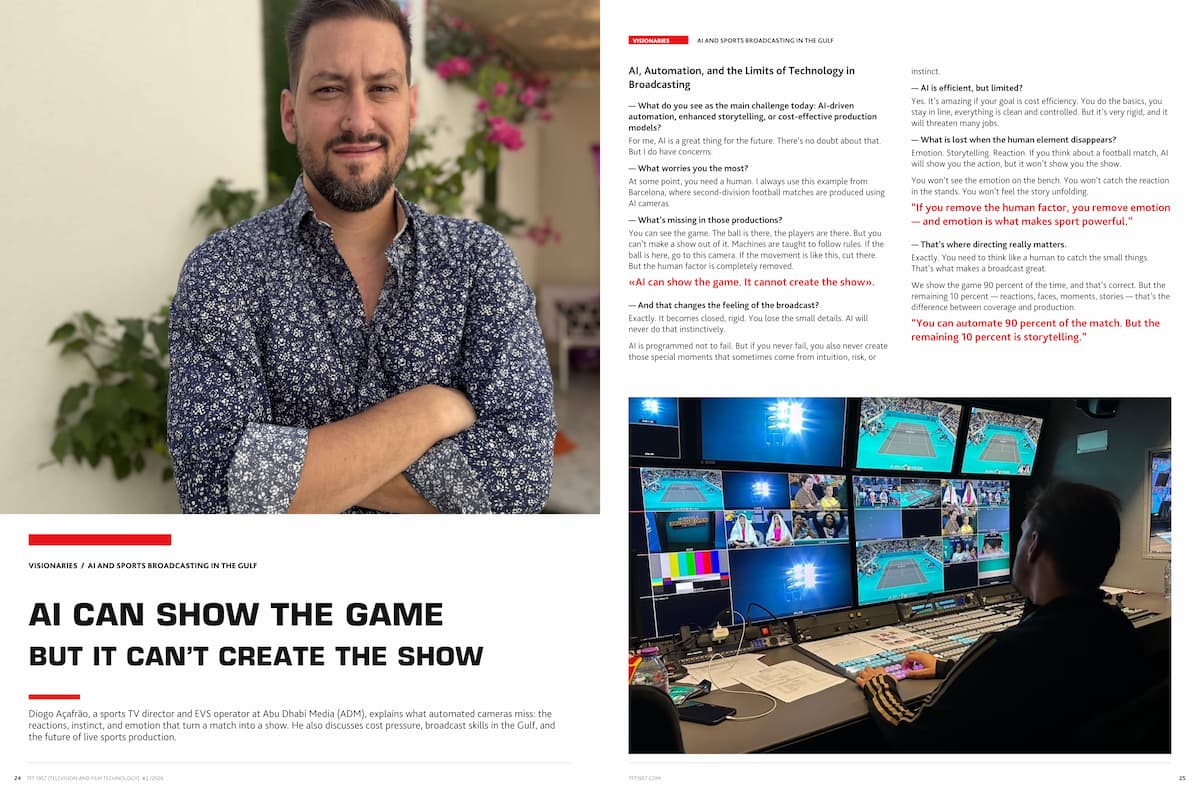
Diogo Açafrão, a sports TV director and EVS operator at Abu Dhabi Media (ADM), explains what automated cameras miss: the reactions, instinct, and emotion that turn a match into a show. He also discusses cost pressure, broadcast skills in the Gulf, and the future of live sports production.
Bridge Technologies Joins Gulf & MENA Decision-Makers Forum as Partner
AI, Automation, and the Limits of Technology in Broadcasting
What do you see as the main challenge today: AI-driven automation, enhanced storytelling, or cost-effective production models?
For me, AI is a great thing for the future. There’s no doubt about that. But I do have concerns.
What worries you the most?
At some point, you need a human. I always use this example from Barcelona, where second-division football matches are produced using AI cameras.
What’s missing in those productions?
You can see the game. The ball is there, the players are there. But you can’t make a show out of it. Machines are taught to follow rules. If the ball is here, go to this camera. If the movement is like this, cut there. But the human factor is completely removed.
“AI can show the game. It cannot create the show.”
And that changes the feeling of the broadcast?
Exactly. It becomes closed, rigid. You lose the small details. AI will never do that instinctively.
AI is programmed not to fail. But if you never fail, you also never create those special moments that sometimes come from intuition, risk, or instinct.
 AI is efficient, but limited?
Yes. It’s amazing if your goal is cost efficiency. You do the basics, you stay in line, everything is clean and controlled. But it’s very rigid, and it will threaten many jobs.
What is lost when the human element disappears?
Emotion. Storytelling. Reaction. If you think about a football match, AI will show you the action, but it won’t show you the show. You won’t see the emotion on the bench. You won’t catch the reaction in the stands. You won’t feel the story unfolding.
“If you remove the human factor, you remove emotion — and emotion is what makes sport powerful.”
That’s where directing really matters.
Exactly. You need to think like a human to catch the small things. That’s what makes a broadcast great.
We show the game 90 percent of the time, and that’s correct. But the remaining 10 percent — reactions, faces, moments, stories — that’s the difference between coverage and production.
“You can automate 90 percent of the match. But the remaining 10 percent is storytelling.”
EVS, Replay Workflows, and the Role of Technology
You continue to work as an EVS operator. Looking at the last ten years, has the workflow changed more toward software products, or is it still largely manual?
No, we do everything on EVS. Highlights, replays, full workflows — everything is done on EVS systems.
Are you referring more to software-based tools or hardware systems?
Hardware. I’ve also worked with Quantel systems in the past, and they produced very solid solutions as well. But EVS has always been the industry standard reference, and I believe it will remain that way.
Even beyond replay operations?
Yes, even for directing. EVS is developing very interesting tools now. For smaller productions, they are doing great things using systems like EVS X1. They really understand live production workflows.
The Current State of the Broadcast Business in the Gulf
How do you assess the current level of the broadcast business in the Gulf countries?
Honestly, I think the level is going down in some areas.
That’s a strong statement. What do you mean by that?
I come from a family where everyone worked in television, so I grew up with a very different mindset. I remember my father telling me that when he operated a camera, he had to do it wearing a suit. Of course, that’s just a symbol, but it reflects something deeper.
What exactly is being lost?
The importance of the profession. The technical depth. The respect for the craft. Today, I work with many people who don’t have proper training or technical formation.
The mindset often is: “You want to do this? Let’s try. You don’t need to do it well. If you do it okay, that’s fine.” We just fill numbers.
Elie Roukoz Joins Gulf & MENA Decision-Makers Forum 2026 as Founding Member
Do you see this as a global problem?
Yes. Not only here. It’s happening everywhere. We don’t have enough ultra-specialized professionals anymore. We have a lot of people, but not enough depth.
You’ve seen this from a management perspective as well.
Exactly. When I worked at a Portuguese news channel, during my last two years there I was supervising the directors. And every time we were about to hire someone, the logic was always the same.
What logic?
You’re always downgrading. You do the best you can with what’s available, but you’re essentially building the house from the ceiling. Everything is upside.
And how does that translate to the Middle East?
In the Middle East, it’s not as extreme, but the issue still exists. Sometimes it’s simply about numbers. “We need 80 people for the rotation.” Maybe 15 of them can just be numbers, but the rest must be properly structured.
What kind of structure do you mean?
A solid core of experienced, well-trained professionals. Then you can complement that with younger or less experienced people who are in formation. That balance is essential.
Do you still believe in developing new talent?
Absolutely. You can always find amazing people if you give them a real chance. I remember when I was supervising in Saudi Arabia, they brought me a young guy. He was 23 at the time.
Emad Awwad Joins Gulf & MENA Decision-Makers Forum 2026 as Founding Member
What was his background?
He told me he wanted to be a camera operator, but he had no live sports experience. He was working on soap operas, but he really wanted to move into sports broadcasting.
And you gave him a chance?
Yes. We gave him a chance. Two years later, he became one of the best camera operators I know today.
But that’s not the norm.
Exactly. That’s one out of a hundred. And that’s the main issue. Today, the industry is driven much more by cost efficiency than by quality.
And that worries you?
Very much. Because quality takes time, training, mentorship, and respect for the craft. If we lose that, we lose the foundation of broadcast production itself.
“We are losing craft in broadcasting because everything today is driven by cost, not quality.”